

Guide to Bed Bug Heat Eradication
- Extreme Bedbug Heat Treatments
- 12 hours ago
- 6 min read

One bed bug sighting is rarely just one bed bug. By the time bites start appearing or you spot activity around a mattress seam, the infestation is often established in places most people never think to inspect. That is why any serious guide to bed bug heat eradication has to start with one fact: success depends on controlled, measured heat reaching every harbourage, not just the obvious areas around the bed.
Bed bugs are difficult because they do not stay still, and they do not stay visible. They move into bed frames, skirting gaps, bedside furniture, soft furnishings, luggage, electrical areas and structural cracks. Eggs are another major problem. A treatment that only knocks down exposed adults is not an eradication. It is a delay.
Why bed bug heat eradication works
Heat works because bed bugs and their eggs cannot survive sustained exposure to lethal temperatures. The principle sounds simple, but in practice the difference between partial control and full eradication comes down to precision. Raising the temperature of a room is not enough on its own. The target is to deliver and maintain lethal heat levels across the entire treated environment, including difficult cold spots where bed bugs naturally retreat.
This is where professional heat treatment separates itself from improvised approaches. A domestic heater, a hired fan heater or a hot wash can help with isolated items, but they do not provide whole-room control. Bed bugs exploit temperature inconsistencies. If one part of the room reaches target temperature but the inside of a divan base, the rear of fitted furniture or a shaded edge near the skirting remains cooler, insects can survive and re-establish.
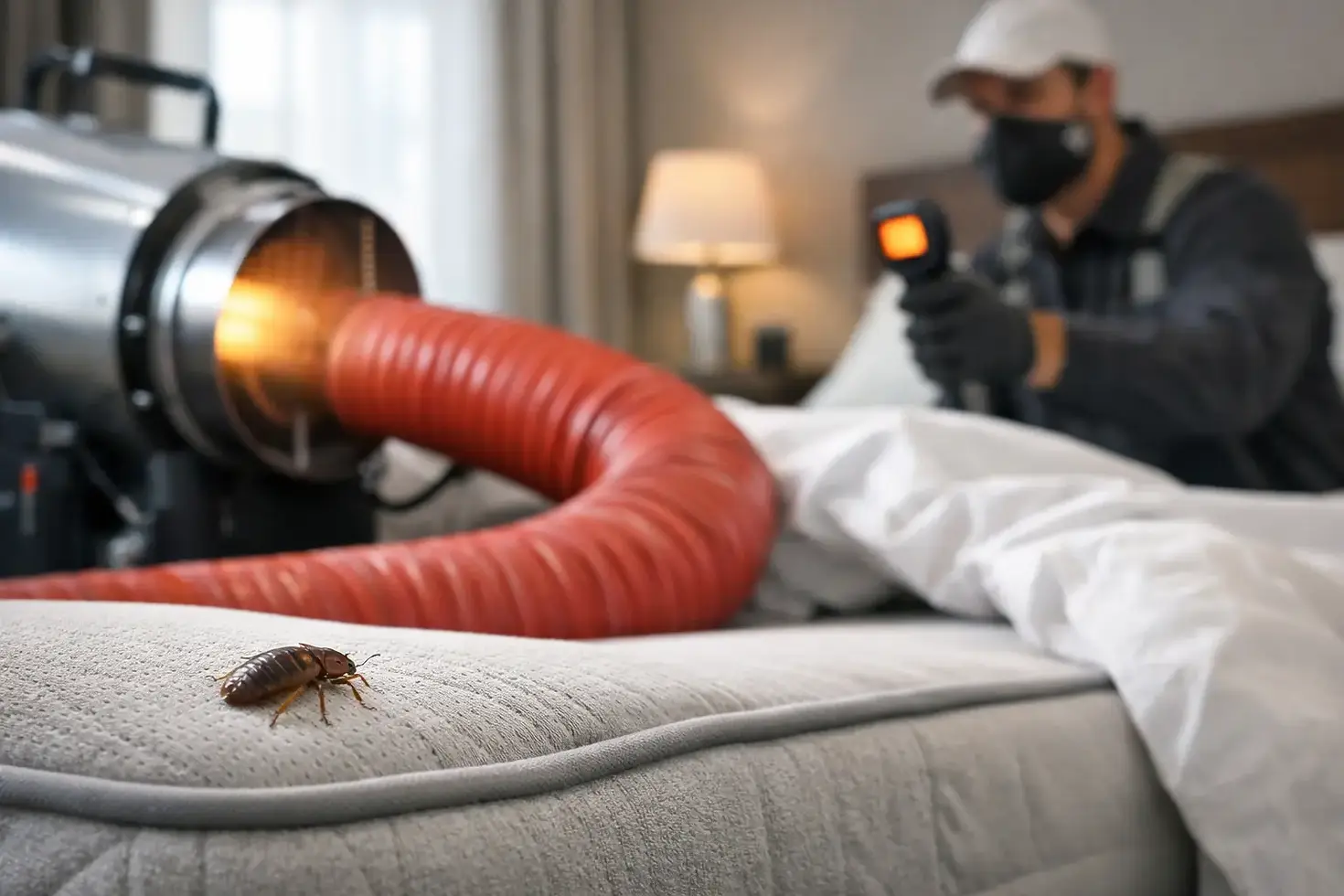
Proper bed bug heat eradication is designed around that reality. It uses industrial heat equipment to build temperature evenly, monitored sensors to track conditions throughout the treatment zone, and thermal checks to identify areas lagging behind. We do not guess, we monitor.
A practical guide to bed bug heat eradication on site
The first stage is assessment. Before heat is deployed, the infestation pattern needs to be understood properly. Bed bugs do not always stay in the room where bites are noticed. In flats, HMOs, hotels and larger homes, spread into adjoining rooms or migration along furnishing lines is common. A technical treatment plan should reflect layout, room contents, likely harbourages and any risks created by clutter, dense materials or inaccessible voids.
Preparation matters, but it should be proportionate. People often assume they need to strip a property bare. In reality, overhandling infested items can spread bed bugs into corridors, vehicles or unaffected rooms. A professional operator will advise what needs laundering, what can stay in place, and how to prepare safely without creating further dispersal.
Once treatment begins, specialist heaters are positioned to generate controlled high temperatures throughout the room or property section being treated. Air movement is managed carefully to drive heat into furnishing layers, joints and hidden voids rather than merely overheating open air. Sensors are placed strategically so temperatures can be tracked in real time at multiple points, including likely cold spots.
This monitoring stage is one of the most important parts of any guide to bed bug heat eradication, because it explains why professional results are repeatable. The objective is not simply to make the space hot. The objective is to confirm that lethal temperatures are achieved where bed bugs are actually hiding, and to hold those conditions for long enough to kill both live insects and eggs.
If a cold spot is identified, the treatment is adjusted. That may mean changing airflow, repositioning equipment, opening up furniture cavities, or applying targeted handheld high-temperature treatment into known harbourages and migration zones. This is technical pest eradication, not a set-and-hope process.
Why sprays often fail where heat succeeds
Spray treatment has a place in pest control, but bed bugs are a classic example of where dependence on insecticides can produce poor outcomes. Resistance is well documented, especially in established infestations and high-turnover environments such as hotels, hostels and multi-occupancy properties. Even where chemicals affect active insects, eggs may remain untouched, and inaccessible harbourages can protect survivors.
There is also the practical issue of disruption. Chemical programmes often require repeated visits and can place restrictions on room use, cleaning routines or occupancy. For households with children, allergy concerns or baby nurseries, and for businesses where room downtime carries a direct cost, that is not a small detail.
Heat treatment avoids many of those weaknesses. It is chemical-free, it targets eggs as well as active stages, and when delivered correctly it can achieve eradication in a single managed visit. That does not mean every job is identical. Heavy infestations, cluttered environments and large or structurally complex properties need a more technical approach. But the advantage remains the same: heat overcomes the resistance problem by using physics rather than relying on insect response to a chemical.
What clients should expect from a professional heat treatment
A credible provider should be able to explain the process in plain terms and back it with technical detail. That means inspection, treatment planning, controlled heat deployment, sensor-based monitoring, verification of sustained temperatures and targeted action where needed. It should also include clear guidance before and after treatment.
For residential clients, discretion and reassurance matter. Bed bug infestations are stressful, and many people feel embarrassed even though the problem has nothing to do with poor hygiene. A professional team should treat the issue matter-of-factly, protect the home environment and focus on results. In bedrooms, nurseries and living areas, chemical-free treatment is often the strongest option for people who want certainty without unnecessary residue.
For landlords, letting agents and property managers, the key issues are liability, speed and recurrence. A room that remains infested after an incomplete treatment quickly becomes a larger operational problem. In hospitality settings, the stakes are even higher. Guest complaints, room loss and reputational damage can escalate very quickly. That is why measured eradication, not basic knockdown, should be the standard.
At Extreme Heat Treatments UK, that process is built around industrial heat machinery, WiFi-monitored sensors, thermal imaging and targeted handheld equipment reaching up to 180 degrees in critical harbourage zones. The point is simple: control every stage, verify every stage, and do not leave survival pockets behind.
The trade-offs and limitations to understand
Heat is highly effective, but a serious article should be clear about the variables. Not every item in a treated area responds in the same way to high temperatures. Heat-sensitive belongings may need assessment and careful handling. Dense clutter can slow heat penetration. Some building layouts create difficult voids or shielded spaces that need additional technical input.
There is also a difference between treating a contained bedroom infestation and treating a dispersed infestation across multiple rooms or units. In blocks of flats or commercial premises, bed bug movement between adjoining areas can complicate eradication if only one section is addressed. This is why inspection and scope matter so much. A good provider will tell you when a wider treatment boundary is required rather than pretending every problem can be solved with the same set-up.
Cost is another factor. Specialist heat treatment is not the cheapest option on paper, but it often proves more economical than repeated spray visits, lost room revenue, replacement furniture and ongoing disruption. Cheap treatment that fails is not cheap.
Aftercare and reducing the risk of reintroduction
Once a bed bug heat treatment has been completed properly, the focus shifts from eradication to prevention. That usually means sensible housekeeping rather than extreme measures. Monitor sleeping areas, be cautious with second-hand furniture, inspect luggage after travel, and respond quickly if fresh signs appear. Delay is what allows a small reintroduction to become a full infestation.
It is also worth understanding that post-treatment anxiety is common. People often become hyper-aware of every mark, itch or fabric speck. What matters is evidence - live insects, cast skins, faecal spotting or confirmed fresh activity. A reliable specialist will explain what is normal after treatment and what would justify follow-up inspection.
The most effective guide to bed bug heat eradication is not one that promises miracles with no conditions. It is one that explains why precision matters, why monitoring matters and why full thermal coverage is the difference between temporary relief and a genuinely eradicated infestation. If you want the problem gone, the method has to reach every place bed bugs rely on to survive. That is the standard worth insisting on.


Comments