


Can One Treatment Remove Bed Bugs for Good?
- Extreme Bedbug Heat Treatments
- 2 days ago
- 5 min read

A bed bug infestation is not a problem most people can live around while they wait for a series of spray visits to work. Bites, lost sleep, anxious guests and the fear of carrying insects into another room all create pressure for a fast answer: can one treatment remove bed bugs? In the right conditions, yes. A professionally planned whole-room heat treatment can eliminate all life stages in a single visit, including eggs. But a single visit only works when the treatment reaches every place bed bugs can hide and stays at lethal temperatures for long enough.
That is the difference between heating a room and carrying out a controlled eradication. Bed bugs do not remain politely on the mattress. They move into bed frames, skirting boards, electrical areas, sofas, wardrobes, luggage, curtain headings and cracks no wider than a credit card. A successful one-treatment result depends on finding and treating those spaces, not simply making the room feel hot.
Can one treatment remove bed bugs completely?
One treatment can remove bed bugs completely when it is a properly monitored professional heat treatment, supported by a thorough inspection and sensible preparation. Heat has a major advantage over many conventional insecticides: it can kill live bed bugs, nymphs and eggs in the same treatment cycle. This matters because eggs are often the reason an infestation appears to return after a spray-only programme.
Bed bugs are increasingly resistant to commonly used insecticides. Even where a chemical application kills exposed insects, it may not penetrate every harbourage or affect every egg. It can also require repeat visits timed around egg hatching. That approach has its place in certain pest-control plans, but it is rarely the quickest route to certainty where bed bugs are established.
Professional heat treatment works by raising the temperature throughout the affected area, then maintaining controlled exposure rather than relying on a short burst of heat. Industrial heaters circulate hot air through the room while technicians use wireless sensors to monitor temperatures continuously. The aim is not a high reading beside a machine. The aim is verified lethal heat in the places insects are most likely to survive.
At Extreme Heat Treatments UK, this is treated as an eradication process, not a guess. Temperature data, thermal imaging and physical inspection are used to identify cold spots and inaccessible harbourages while the treatment is in progress. Areas where bed bugs may migrate or shelter can then receive targeted high-temperature treatment with handheld equipment.
Why a single heat treatment can fail
A one-visit treatment is powerful, but no legitimate specialist should pretend that every infestation presents the same conditions. The main risks are not usually the bed bugs themselves. They are cold spots, poor access, untreated adjoining areas and reintroduction after treatment.
Cold spots protect insects
Heat naturally rises, while dense furniture, piled belongings, deep drawers and poorly ventilated voids can lag behind the wider room temperature. A bed bug hidden in a cooler pocket may survive even though the rest of the room has reached the required level.
This is why a domestic fan heater, steam cleaner or turning up the central heating is not an alternative to professional treatment. It cannot reliably create, circulate and verify the conditions needed across an entire infested room. Professional equipment is deployed strategically, with air movement managed to push heat into difficult areas. Remote sensors show where temperatures are holding and where further action is needed.
Bed bugs may be outside the obvious room
The bed is often the centre of the infestation, but it is not always the boundary. In flats, terraced homes, hotels and hostels, bed bugs can travel through pipe routes, service voids, corridors, adjoining rooms and shared furniture. A treatment limited to one bedroom may be insufficient if evidence points to wider activity.
A proper survey considers where people sleep, rest and store belongings, as well as where bites are being reported. In commercial premises, this may mean assessing neighbouring guest rooms, staff areas or luggage storage. Treating the correct footprint is essential to a 100% guaranteed result.
Preparation affects access, not the heat’s ability to kill
Customers are sometimes told to bag every possession, empty every drawer and strip a property bare before treatment. That can be disruptive and, in some cases, it causes bed bugs to spread through the building as items are moved.
The correct preparation plan depends on the property and treatment method. For whole-room heat, belongings can often stay in place so they are treated with the room, provided technicians can circulate heat safely and access key areas. Some heat-sensitive, pressurised or combustible items will need removing or protecting. Laundry and clutter may need specific handling. Clear instructions should be provided before the visit, based on the rooms involved.
The key point is simple: do not start moving infested furniture or bags into communal areas, another bedroom or a relative’s house. That can turn a contained problem into several new ones.
What a single-visit bed bug treatment should involve
A reliable single-treatment result is built before the heaters are switched on. It begins with evidence gathering. Technicians need to inspect beds, furniture, seams, fittings, soft furnishings and likely migration routes to understand the infestation and determine the treatment area.
Once the plan is agreed, industrial heat machines are positioned to heat the space evenly. Sensors are placed in representative locations, including known risk areas, so temperatures can be monitored through WiFi-enabled systems rather than assumed from the air near the heater. Technicians adjust equipment as the treatment progresses, responding to readings and checking that the required exposure is sustained.
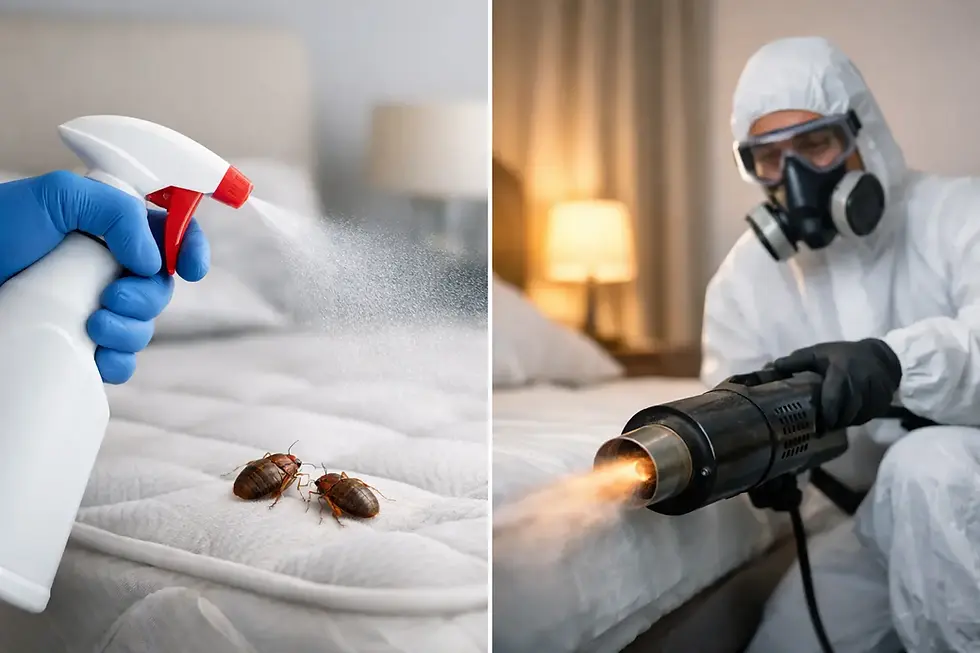
Thermal imaging helps reveal where heat is not travelling as expected. Dense furniture may need opening, moving or directing with airflow. Handheld high-temperature equipment - capable of producing around 180-degree heat - can be used carefully on bed frames, joints, edges, cracks and migration zones that demand additional attention.
The treatment is not complete when a set temperature first appears on a display. It is complete only after the full treatment area has achieved the required conditions for the necessary duration. This is why professional heat treatment is precise work. We do not guess, we monitor.
Does one treatment mean no more bed bugs ever?
A successful treatment removes the infestation that is present at the time. It cannot prevent bed bugs being brought back into a property later in luggage, second-hand furniture, laundry, visitors’ belongings or stock moving through a hospitality setting. That is reintroduction, not treatment failure.
For homeowners and tenants, a few practical habits reduce that risk. Check second-hand beds, sofas and upholstered furniture before bringing them indoors. Keep suitcases off hotel beds and inspect them after travelling. If you suspect bed bugs after a stay away, isolate luggage before unpacking it across the home.
For landlords, managing agents and hotel operators, speed matters. A report of bites or a confirmed sighting should trigger a discreet assessment before occupants, guests or furniture movements spread the issue further. Documenting affected rooms and acting on evidence is far more effective than waiting for complaints to multiply.
When another visit may be sensible
A follow-up inspection or further treatment may be appropriate where the infestation footprint was unclear, access was restricted, adjoining areas could not be assessed, or there is a credible risk of ongoing introduction. Large multi-occupancy buildings can also require a wider management plan, particularly if bed bugs are moving between units.
That does not mean heat treatment has failed as a method. It means the property needs to be treated as the real environment it is - with its shared walls, cluttered storage, changing occupants and practical access limits. Honest diagnosis protects the result.
If you are seeing fresh signs after a treatment, do not immediately assume every mark is a new bite. Skin reactions can linger, and old spotting may be noticed only once you start looking closely. Keep any evidence, take clear photographs and report it promptly so it can be assessed properly.
The fastest route out of a bed bug problem is not the cheapest-looking treatment or the hottest machine. It is a controlled plan that reaches the whole infestation, monitors the result and gives you clear instructions for keeping the property protected afterwards.

Comments