


Bed Bug Heat Treatment in Cambridgeshire
- Extreme Bedbug Heat Treatments
- 18 hours ago
- 6 min read

You usually know something is wrong before you ever see a bed bug. Repeated bites, dark spotting on bedding, a growing sense that sleep has become a problem - that is often how bed bug heat treatment in Cambridgeshire starts. By the time most people call, they are not looking for theory. They want the infestation removed properly, without half measures, and they want confidence that eggs, hidden adults and newly emerged nymphs are all being dealt with.
That is exactly where professional heat treatment stands apart from standard spray-led approaches. Bed bugs are difficult because they do not stay neatly in one visible area. They move into bed frames, skirting gaps, bedside furniture, sockets, soft furnishings and luggage. In larger properties and commercial sites, they can spread room to room through cracks, service routes and adjoining spaces. A treatment that only reaches exposed insects is not enough.
Why bed bug heat treatment in Cambridgeshire is different
Heat treatment works by raising target areas to lethal temperatures and holding those temperatures for long enough to kill all life stages, including eggs. That last point matters. Eggs are one of the reasons infestations return after weaker treatments. If eggs survive, the problem is not solved. It is delayed.
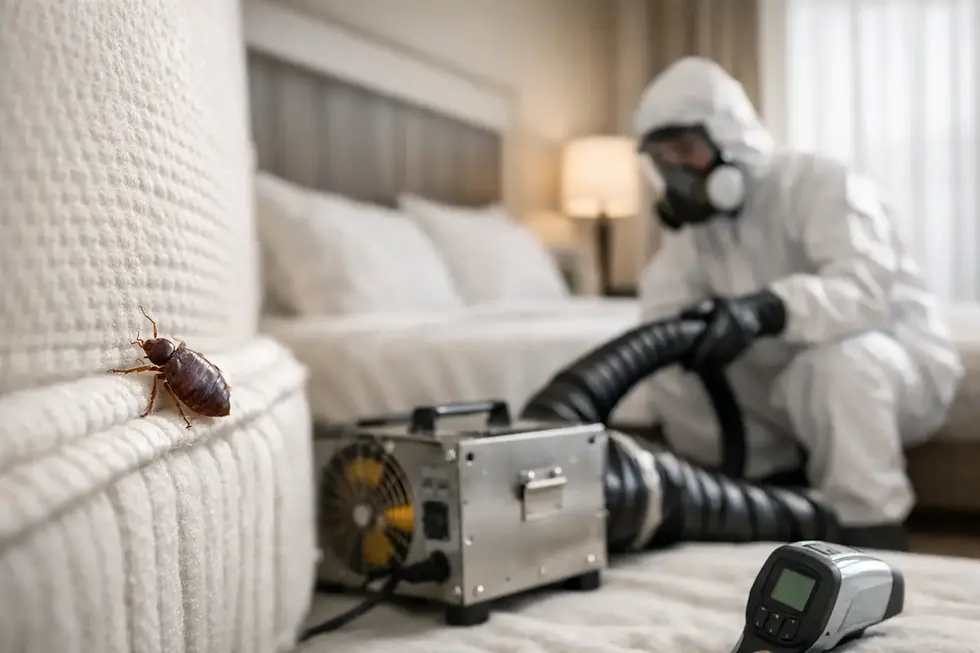
A specialist heat process is not simply a case of making a room hot. The result depends on controlled heat build-up, correct machine placement, constant sensor readings and the identification of colder areas where bed bugs may survive. This is why a serious operator uses monitored probes, thermal imaging and handheld equipment to push heat into voids, seams, edges and migration points.
In practical terms, that means the treatment is based on evidence rather than assumption. We do not guess, we monitor. If one part of a room or furniture item is lagging behind temperature target, it is identified and corrected during the treatment, not discovered later when the infestation reappears.
The problem with repeated chemical treatments
For many households, landlords and hospitality operators, the real frustration is not the first infestation. It is the failed treatment cycle that follows. One visit becomes two, then three. Sprays may reduce visible activity, but bed bugs can remain hidden deep in cracks and fabric folds. In some cases, insecticide resistance is also a factor.
That is why bed bug control has shifted for many serious infestations towards heat-led eradication. A properly managed thermal treatment does not rely on bed bugs contacting a chemical residue. It uses lethal heat penetration across the treated environment. When applied with precision, it reaches the harbourages that often defeat conventional methods.
There are situations where chemical support may still have a place, particularly in complex multi-unit environments or where external risks remain high. But for people who want a chemical-free main treatment inside bedrooms, nurseries, rental homes or guest accommodation, heat is often the more decisive option.
What a professional treatment actually involves
The first step is understanding the scale and layout of the infestation. In a one-bedroom flat, the treatment plan may be relatively contained. In a detached house, HMO, hotel room block or staff accommodation setting, the risk picture is broader. Bed bugs do not respect tenancy lines or room labels. If they have had time to spread, neighbouring rooms and connecting areas may need attention as well.
Once the treatment area is established, industrial heat machines are positioned to raise ambient temperatures evenly and safely. Sensors are then placed in critical locations to measure how heat is behaving across the room and within likely harbourages. This is where technical control matters. Air temperature alone does not tell the full story. Surface materials, furniture density, clutter levels and structural voids all affect heat transfer.
During the treatment, readings are monitored continuously. Cold spots are identified and corrected. Where required, handheld high-temperature equipment is used to target stubborn areas such as bed frames, upholstered seams, floor edges, cracks, behind headboards and known movement routes. This focused approach is one of the main differences between a basic heat attempt and a specialist eradication process.
The aim is not to warm the room. The aim is to eliminate the infestation completely.
Where bed bugs hide in Cambridgeshire homes and businesses
In domestic settings, bed bugs are commonly found around mattresses, divan bases, slatted frames, bedside cabinets, curtains and soft chairs. They also travel further than many people expect. It is not unusual to find activity behind skirting, inside drawer units, under carpet edges and near electrical points. In shared houses and flats, they may move with people, laundry and personal belongings.
In commercial settings such as hotels, hostels and serviced accommodation, the challenge is often speed and containment. One affected room can quickly become a wider operational issue if the infestation is allowed to continue. Offices, staff rest areas and even community buildings can also be affected where upholstered furniture or transient use creates suitable conditions.
That is why a credible treatment has to look beyond the obvious sleeping area. If the process ignores dispersal routes and secondary harbourages, the infestation can survive on the margins and rebuild.
Why precision matters more than speed alone
Customers often ask how quickly heat treatment works. The honest answer is that the active eradication happens on the day, but the quality of the result depends on preparation, equipment capacity and monitoring discipline. Fast is useful. Controlled is essential.
There is a trade-off here. A rushed treatment may sound attractive, especially for landlords under pressure or hospitality venues trying to return rooms to service. But if temperatures are not sustained properly throughout the right locations, speed becomes false economy. Bed bugs are highly vulnerable to heat when lethal thresholds are actually achieved. The technical challenge is making sure that happens everywhere it needs to happen.
This is why single-visit treatment can be so effective when delivered properly. It combines whole-room exposure with targeted thermal application and live monitoring, rather than relying on repeated visits and hope. For many clients, that means less disruption overall and far greater certainty.
Is heat treatment safe for occupied properties?
When carried out by trained specialists, heat treatment is a controlled professional process. It is particularly attractive to households that want to avoid widespread pesticide use in sleeping areas, family homes and sensitive environments. It is also well suited to clients who value an environmentally responsible approach.
That said, preparation instructions matter. Items sensitive to heat may need to be removed or managed before treatment begins. A proper provider will make this clear in advance and explain exactly what is required. Good results depend on cooperation as well as equipment.
For landlords and managing agents, this planning stage is also useful because it sets expectations clearly. Access, occupancy, adjoining rooms and previous treatment history all affect how the visit is organised. Precision on paper supports precision on site.
Choosing a specialist for bed bug heat treatment in Cambridgeshire
Not every pest control company offering bed bug work is a heat treatment specialist. That distinction matters. The equipment, treatment logic and monitoring standards are different. If the service sounds vague, that is usually a warning sign.
A serious provider should be able to explain how temperatures are measured, how long lethal conditions are maintained, how cold spots are identified and what is done about bed bug movement zones. They should also be clear about the treatment scope. Is it one room, an adjoining set of rooms, or a whole property response based on spread? That decision should be driven by inspection evidence, not guesswork.
This is where a specialist operator such as Extreme Heat Treatments UK stands out. The process is built around controlled heat exposure, WiFi-monitored sensors, thermal imaging and targeted handheld treatment of difficult areas, with a 100% guarantee. That is the level of discipline required when the goal is eradication rather than reduction.
When to act
If you suspect bed bugs, delay usually makes the job harder. Infestations spread through use of the room, movement of belongings and normal day-to-day living. The longer they remain active, the greater the chance they will establish themselves in additional furniture and adjoining spaces.
The best time to deal with bed bugs is early, but effective action still matters even when the infestation has become established. What counts is choosing a method that addresses the full life cycle and the full treatment area with measurable control.
If your priority is a chemical-free solution, a properly managed thermal process gives you a direct path to complete eradication. For homes, rentals and commercial premises across Cambridgeshire, that means fewer assumptions, fewer repeat failures and a far better chance of getting your space back in one decisive visit.
When bed bugs are affecting sleep, reputation or day-to-day operations, certainty is worth more than promises. Choose the treatment that is monitored, proven and built to finish the job properly.


Comments