


Can You Kill Bed Bugs Yourself?
- Extreme Bedbug Heat Treatments
- 18 hours ago
- 6 min read

You usually ask, can you kill bed bugs yourself? after the problem has already stopped being a minor irritation. You have seen bites, spotted marks on the mattress, or found insects tucked into seams, bed frames or skirting gaps. At that point, the real question is not whether you can kill some bed bugs. It is whether you can eliminate the infestation fully, including the eggs, the hidden adults and the insects that have already moved beyond the bed.
The honest answer is yes, you can kill some bed bugs yourself. What is much harder is killing all of them. That distinction matters, because partial treatment is exactly how bed bug problems drag on for weeks or months.
Can you kill bed bugs yourself and actually solve the problem?
Bed bugs are not difficult because they are indestructible. They are difficult because they are exceptionally good at hiding, spreading and surviving poor treatment. A householder can kill visible insects with direct heat, steam, washing, tumble drying and careful vacuuming. Those methods are real and they do work on contact.
Where DIY usually fails is coverage and control. Bed bugs do not stay politely on the mattress waiting to be treated. They move into bed frames, headboards, bedside units, curtain folds, sofas, electrical areas, flooring edges and wall junctions. In heavier infestations, they can travel into neighbouring rooms and adjacent units. If even a small number survive, the problem returns.
That is why bed bug eradication is not just about temperature or products. It is about reaching the right temperature in the right places for long enough, then confirming that no untreated cold spots remain.
What you can do yourself
If you have caught the issue very early, there are sensible steps you can take immediately. Strip bedding, bag it before moving it through the property, and wash and dry it on high heat where fabric care allows. Tumble drying is particularly useful because sustained heat is lethal to bed bugs and eggs.
Vacuuming can reduce numbers, especially around mattress seams, bed joints, skirting edges and upholstered furniture. It is not a complete treatment, but it can remove live insects and debris. The vacuum contents must then be sealed and disposed of properly. Simply vacuuming and carrying on as normal achieves very little.
Steam can also kill bed bugs on contact, provided the unit produces sufficient heat and is used slowly enough for the heat to transfer. This is where many DIY attempts fall short. People move too quickly, use unsuitable devices or treat only open surfaces while insects remain deeper inside furniture or behind fittings.
Decluttering helps as well, not because clutter causes bed bugs, but because it gives them more harbourage. The more hiding places they have, the harder it is to inspect and treat thoroughly.
These steps are useful. They can lower activity, reduce spread and buy time. They should not be mistaken for guaranteed eradication.
Why bed bugs keep coming back after DIY treatment
The usual reason is not effort. It is incomplete treatment. Bed bug eggs are small, well concealed and resistant to many off-the-shelf approaches. If eggs survive, they hatch and the cycle restarts. If adults or nymphs remain tucked into colder, protected areas, they emerge later and the infestation appears to return from nowhere.
Another common problem is insecticide resistance. This is one of the biggest reasons standard spray-based treatments have become unreliable in many cases. A product may kill some insects and miss others entirely. That creates false confidence, followed by renewed bites a week or two later.
There is also the issue of migration. Disturbing a bed bug infestation without controlling the full area can drive insects further into the property. A hurried spray around the bed may push them into sofas, wardrobes, hallway edges or neighbouring rooms. In flats, bedsits, HMOs and hospitality settings, that risk becomes even more serious.
The limits of home heat methods
People often hear that heat kills bed bugs and assume any hot device will do the job. The principle is correct. The execution is where it fails.
For heat treatment to work properly, the target area must reach lethal temperatures throughout the infestation zone, not just on exposed surfaces. That means the heat has to penetrate into furniture, fabrics, joints, cavities and the exact locations where insects and eggs are hiding. It also has to be maintained and monitored. If one area remains too cool, bed bugs survive there and repopulate.
A domestic hairdryer, clothes steamer or portable heater is not the same as a controlled professional heat system. Home devices can kill on direct contact, but they rarely heat an entire room or property in a measured, sustained and verifiable way. Worse, badly managed heat can damage belongings without solving the infestation.
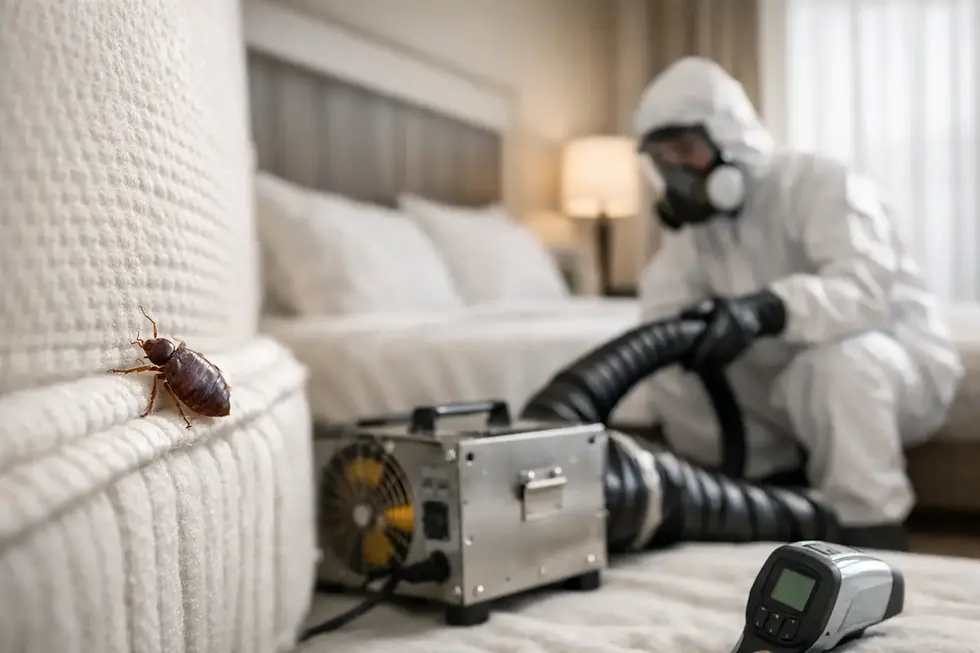
Professional heat eradication works because it is engineered. Industrial equipment raises the treatment area to the required temperature, sensors monitor performance, cold spots are identified, and handheld high-temperature tools are used on difficult locations and migration routes. We do not guess, we monitor.
Can you kill bed bugs yourself if the infestation is small?
Possibly, but only if it is genuinely small, very localised and found early. That usually means one item of furniture, one sleeping area and no signs of spread beyond that immediate zone. Even then, success depends on disciplined preparation and repeated, careful inspection.
The difficulty is that most people underestimate the extent of a bed bug problem. By the time bites are noticed consistently, insects have often been active for some time. They may already be behind the headboard, inside bedside furniture, under carpet edges or in soft furnishings elsewhere in the room.
For landlords, property managers and hospitality operators, DIY is even more risky. The cost of delay is rarely just discomfort. It can mean complaints, void periods, reputational damage and wider spread through a building. In those environments, speed and certainty matter more than trying three cheaper methods that fail in sequence.
When professional treatment becomes the sensible option
If you are seeing repeated activity after washing, steaming or vacuuming, the infestation is no longer a good DIY candidate. The same applies if bites continue, if multiple rooms are involved, if the property is shared, or if vulnerable spaces such as baby rooms and guest accommodation are affected.
Professional treatment is not simply about stronger kit. It is about method. A specialist approach starts with identifying harbourage, assessing spread, planning heat deployment and understanding where bed bugs are likely to migrate as temperatures rise. Treatment is then monitored in real time so the whole process is controlled rather than assumed.
This is why chemical-free heat treatment has become the preferred route for many serious infestations. It addresses live insects and eggs in one coordinated process, avoids reliance on insecticides where resistance is a factor, and can often be completed in a single visit. For clients who want a thorough result with minimal chemical exposure, especially in bedrooms and sensitive living areas, that matters.
At Extreme Heat Treatments UK, that process is built around industrial heat machines, WiFi-monitored sensors, thermal imaging and targeted handheld treatment for colder or higher-risk areas. The point is precision. If a location needs more heat, more time or more direct treatment, it is dealt with there and then.
What to avoid if you are trying to tackle bed bugs yourself
Do not move infested items through the property unbagged. Do not sleep in another room and leave the original room untreated, because this can encourage spread. Do not rely on one spray, one steam pass or one frantic clean as proof the job is finished.
Also be careful with internet advice that treats all infestations as equal. A single chair in a spare room is not the same as an established infestation in a family home, a rental flat or a hotel bedroom. The right response depends on extent, access, furnishing type and how long the activity has been present.
Most of all, do not confuse reduced activity with eradication. Bed bugs often appear to disappear before they re-emerge.
The practical answer to can you kill bed bugs yourself
Yes, you can kill bed bugs yourself. You can kill visible adults, disturb harbourages and reduce numbers. In very early, very limited cases, you may even stop the infestation.
But if your real goal is complete eradication, DIY has clear limits. Bed bugs exploit missed areas, surviving eggs and untreated cold spots. That is why so many people spend time and money on repeat attempts before moving to specialist treatment.
When certainty matters, the most effective route is a controlled heat process that reaches all life stages, monitors treatment conditions properly and deals with the hidden areas where bed bugs actually survive. If you are facing repeat bites, recurring signs or a growing problem, the smartest move is not more guesswork. It is choosing a method built to finish the job properly.


Comments