


Why Use Diesel Bed Bug Heaters Over LPG Gas
- Extreme Bedbug Heat Treatments
- Jun 9
- 6 min read

When a bed bug infestation needs to be eradicated properly, the heating system matters just as much as the operator. People often ask why use diesel bed bug heaters rather than dangerous LPG gas heaters, and the answer comes down to control, safety and treatment quality. Heat treatment only works when temperatures are raised evenly, held for long enough, and monitored properly across the whole room or property.
This is where many non-specialist setups fail. Bed bugs do not need much of a temperature gap to survive. If one side of a divan base, a crack behind a skirting board or the centre of a cluttered wardrobe stays cooler than the rest of the room, live insects and eggs can remain in place. A professional heat treatment is not about blasting hot air into a room and hoping for the best. It is about creating a controlled lethal environment and proving that every critical area reached target temperature.
Why use diesel bed bug heaters rather than dangerous LPG gas heaters?
The simplest answer is that diesel-powered systems are better suited to controlled pest eradication inside occupied buildings and sensitive commercial premises. LPG gas heaters may produce heat, but heat alone is not enough. In bed bug work, the real question is how that heat is generated, introduced, distributed and monitored.
Diesel heaters are commonly used as part of a managed indirect heating process. That matters because it allows technicians to raise temperatures in a deliberate, measured way rather than dumping combustion-based heat directly into treatment areas. The result is a more stable heat profile, fewer sharp fluctuations and greater operational control. For bed bugs, that difference is critical.
LPG gas heaters also carry practical and safety concerns that make them a poor choice in many pest control settings. Open-flame or direct gas-based heating introduces additional risk factors that simply should not be normalised in homes, hotels, hostels and other enclosed spaces. When you are treating bedrooms, soft furnishings, electrical items, fitted furniture and personal belongings, precision has to come before raw output.
Heat treatment is only as good as its control
A proper bed bug heat treatment has one job - to push insects and eggs beyond their thermal tolerance everywhere they are hiding. That means technicians need to understand airflow, heat stacking, room volume, insulation loss, hidden voids and migration routes. They also need to monitor temperatures continuously, not guess.
This is why specialist operators favour systems that integrate well with sensor-led treatment plans. Diesel heat equipment can be deployed alongside remote probes, WiFi-monitored sensors and thermal imaging to verify what is really happening within a room. If a cold spot develops behind a headboard or under stored items, it can be identified and corrected during treatment.
By contrast, a cruder gas-heating approach can create the illusion of success. The room may feel very hot at standing height while cooler, protected zones remain below lethal threshold. Bed bugs exploit those cooler zones. Eggs are particularly unforgiving if temperatures have not been sustained correctly.
The safety case against dangerous LPG gas heaters
Calling LPG gas heaters dangerous is not marketing language. It is a practical assessment of the risks involved when gas-fired heating is used in enclosed treatment environments.
The first concern is combustion. Any system that relies on burning fuel near or within the treatment space demands careful consideration of ventilation, by-products and fire risk. In pest control, there is no reason to introduce extra hazards where safer and more controllable alternatives exist.
The second concern is moisture. Some gas heating methods can introduce water vapour as a by-product of combustion. That is unhelpful in bed bug treatment, particularly in furnished spaces where condensation and damp-related effects are unwelcome. Pest eradication should solve one problem, not create another.
The third concern is uneven delivery. Gas systems can produce intense localised heat, which raises the risk of hotspots near the unit while other parts of the room lag behind. Hotspots are not a sign of a better treatment. They are often a sign of poorer control.
For landlords and hospitality operators, the risk profile matters even more. You are not simply trying to clear an infestation. You are also protecting property, contents, staff, guests and your own liability position. A specialist heat treatment should reduce risk, not add to it.
Why diesel works better for precision-led bed bug eradication
Diesel-based heat systems are not effective because they are diesel. They are effective because, in the right hands, they support a controlled treatment methodology. That includes staged heat-up, managed air movement, constant monitoring and targeted intervention where needed.
In practice, a room or property is assessed first. Technicians look at layout, contents, likely harbourage areas, insulation characteristics and any factors that may slow heat penetration. Heaters are then positioned as part of a planned setup, not dropped in arbitrarily. Air movers help drive heated air into difficult areas. Sensors are placed in known risk points such as mattresses, bed frames, sofas, skirting-level voids and packed storage zones.
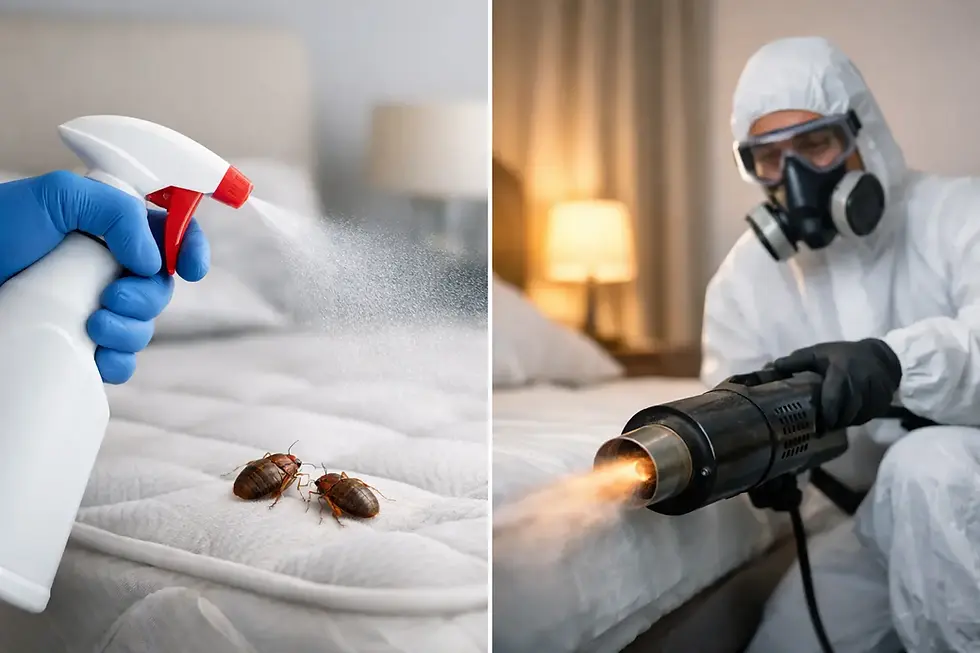
As temperatures rise, readings are tracked in real time. If one area is lagging, the setup is adjusted. If thermal imaging reveals a cooler section behind fitted furniture, that area receives direct attention. If insects attempt to move away from rising heat, handheld high-temperature equipment can be used to treat escape routes and stubborn pockets.
That is what professional heat treatment looks like. It is engineered, observed and corrected throughout the job.
Bed bugs do not care how hot the room feels
This is one of the biggest misunderstandings in the market. Occupants often judge heat treatment by comfort level - if a room feels unbearably hot, surely everything inside it must be dead. That is not how bed bugs work.
Bed bugs hide in tight, insulated spaces. They sit behind sockets, inside furniture joints, under carpet edges, within folded fabrics and deep in belongings. Eggs are tucked into protected cracks where ambient room temperature does not tell the full story. What matters is the temperature inside those harbourages and how long it is maintained.
That is another reason why using diesel bed bug heaters rather than dangerous LPG gas heaters is the right question. The serious issue is not fuel preference in the abstract. It is whether the system allows a specialist operator to verify lethal exposure where bed bugs are actually living.
Residential and commercial properties need a system that can be trusted
For homeowners, safety and certainty usually come first. Many people want a chemical-free treatment because they are dealing with bedrooms, children, pets or sensitive living spaces. They do not want pesticide residues, repeat spray visits or a process that leaves doubt behind. They want one properly managed treatment with evidence that the infestation has been hit hard across every target area.
Commercial clients face the same technical problem with even higher stakes. In hotels, hostels and other accommodation settings, a missed infestation can become a reputational issue very quickly. In rental property, failure to eradicate thoroughly can lead to repeated complaints, room downtime and escalating costs. The heating method therefore needs to support reliability, not just heat output.
A precision-led diesel heat treatment approach is better aligned with that requirement. It gives operators the ability to monitor, document and adjust. That is far more defensible than relying on a rougher gas-based method and assuming the job is done.
It still depends on the operator
No heating system is a magic fix on its own. Poor planning, bad sensor placement, insufficient airflow and inadequate treatment duration can undermine any bed bug heat job. That is why equipment choice should always be considered alongside the operator's process.
Ask how temperatures are monitored. Ask how cold spots are identified. Ask what happens if bed bugs migrate during treatment. Ask whether eggs are specifically accounted for in the treatment duration. These are the questions that separate specialist work from generic heat hire.
At Extreme Heat Treatments UK, the emphasis is straightforward - we do not guess, we monitor. That means combining industrial heat machines with remote sensors, thermal imaging and targeted handheld treatment so the process is driven by measured results rather than assumptions.
The real reason to avoid dangerous LPG gas heaters
The strongest reason to avoid LPG gas heaters in bed bug treatment is not that they never produce heat. It is that bed bug eradication demands more than heat. It demands controllable, measurable and safer delivery inside real buildings with real contents and real people affected by the outcome.
If you are choosing between systems, focus on which method gives the operator the greatest control over temperature consistency, treatment verification and on-site safety. In almost every serious bed bug scenario, that points towards diesel-powered specialist heat equipment rather than dangerous LPG gas heaters.
When you are trying to eliminate bed bugs properly, the best setup is the one that leaves the least to chance.


Comments