


Thermal Remediation Versus Steam Cleaning

A bed bug infestation is rarely confined to the one seam where an insect was first seen. It can extend behind headboards, inside divan bases, under flooring edges, through bedside furniture and into adjoining rooms. That is the practical difference at the centre of thermal remediation versus steam cleaning: one method treats the space as a controlled environment, while the other treats the precise surface the operator can reach.
Steam has a valid role in pest control. It can kill insects and eggs on direct contact, without applying insecticide. But direct contact is the key condition. For a widespread or established infestation, particularly in a furnished bedroom, flat, hotel room or multi-room property, steam alone may leave too many hiding places untreated.
Thermal Remediation Versus Steam Cleaning: The Core Difference
Thermal remediation raises the temperature throughout a sealed treatment area until lethal heat reaches the required level for a sustained period. Professional equipment circulates hot air through the room or property, while multiple wireless sensors monitor temperatures in real time. The objective is not simply to make the room hot. It is to make sure the heat reaches the places pests use to survive.
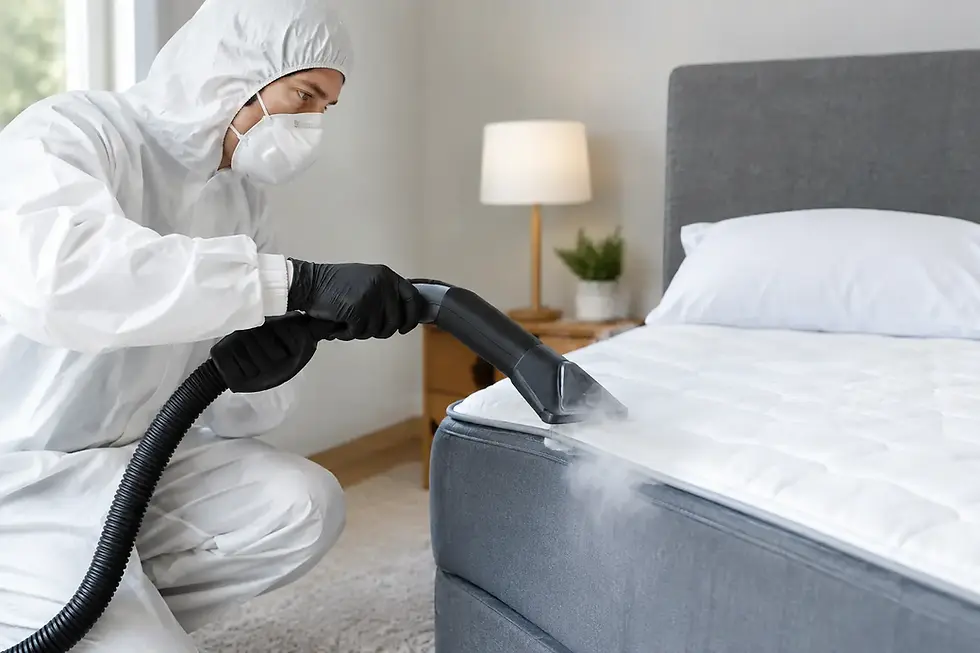
Steam cleaning applies very high heat through a nozzle to an individual surface. A trained operator moves slowly across mattress seams, bed frames, upholstery, cracks and other accessible harbourage points. The steam must reach the insect or egg at the right temperature and for long enough to be effective.
Both methods rely on heat rather than residual chemicals, but their coverage is fundamentally different. Steam is a contact treatment. Thermal remediation is a whole-room or whole-property treatment, depending on the treatment plan.
For bed bugs, this distinction matters because they do not stay neatly on the mattress. They move when disturbed, follow wiring routes, hide behind skirting boards and occupy voids that cannot be reliably treated with a steam nozzle. The same principle can apply to fleas in carpeted rooms and clothes moths in wardrobes, textiles and difficult-to-access areas.
Where Steam Cleaning Works Well
Steam can be highly effective as a targeted measure when the infestation is small, the affected materials are accessible and the operator knows exactly where activity is located. It is useful on mattress piping, upholstered furniture, bed joints and visible cracks where insects are likely to harbour.
It can also form part of a wider professional treatment plan. For example, handheld high-temperature equipment may be used to address specific migration zones or awkward points after the main heat treatment has exposed the full extent of the problem.
The limitations are operational rather than theoretical. Steam does not travel through solid materials in the same way as circulating heat. It may not reach deep inside a divan base, behind fixed furniture, within wall voids or beneath the edges of fitted flooring. Passing the nozzle too quickly reduces the delivered heat, while applying too much moisture can create dampness concerns for fabrics, wood finishes and sensitive furnishings.
There is also a risk of dispersal. If bed bugs are disturbed but not killed, they may retreat into cooler harbourage areas. A homeowner using a domestic steam cleaner can therefore see a short-term reduction in visible activity without achieving complete eradication.
Why Controlled Heat Reaches Further
A professional thermal remediation programme is designed around temperature, airflow, time and verification. Industrial heaters introduce controlled heat into the treatment area. Air movers circulate that heat around furniture, into room edges and across the areas where insects may be concealed. Sensitive items are assessed and protected before treatment begins.
The treatment is then monitored, not guessed. Wireless temperature sensors are positioned throughout the area, including known risk points and likely cold spots. Remote monitoring allows the technicians to see whether every part of the treatment zone is reaching the required temperature. Thermal imaging can help identify areas where heat is not distributing as expected.
Cold spots are the reason professional heat treatment cannot be reduced to simply placing heaters in a room and shutting the door. Dense furniture, external walls, heavy textiles, cupboards and poor airflow can all affect the temperature profile. If a cold zone remains below the lethal threshold, it may provide a refuge for insects and eggs.
Once the required conditions are achieved, the heat is maintained for the necessary duration. This sustained exposure is what gives thermal remediation its strength against all life stages, including eggs. Bed bug eggs are often the failure point in incomplete treatments. A method that kills visible adults but misses eggs can result in renewed activity weeks later.
Which Method Is Better for Bed Bugs?
For a single, clearly identified harbourage point, steam may be an appropriate targeted tool. For a confirmed infestation with activity in more than one location, thermal remediation is generally the more reliable primary treatment because it addresses the room rather than only the places that are easy to see and reach.
This is especially relevant in bedsits, shared houses, blocks of flats and hospitality settings. Bed bugs can move through luggage, laundry, furniture, service routes and adjoining spaces. Treating one visible corner while leaving the wider environment untreated may not resolve the source of the problem.
Thermal remediation is also valuable where insecticide resistance is a concern. Bed bugs have developed resistance to some commonly used chemical products, which can make repeated spray-led treatments frustrating, disruptive and uncertain. Heat works through controlled lethal exposure, not through a pest’s susceptibility to a particular active ingredient.
That does not mean every situation requires a whole-property heat treatment. A proper inspection should determine the extent of activity, the type of pest, the layout of the property and the practical constraints. The right treatment is based on evidence, not a standard package.
Moisture, Preparation and Disruption
Steam introduces moisture. In small, controlled applications this may be manageable, but overuse can leave fabrics or furniture damp. Drying time can be inconvenient in bedrooms, hotel rooms and furnished rental properties. Steam also requires the operator to access each target surface individually, which can make comprehensive treatment labour-intensive.
Thermal remediation is typically a dry process, but it requires careful preparation. Heat-sensitive belongings, aerosols, candles, some medications, certain cosmetics and other vulnerable items may need to be removed or protected. Technicians will advise on the preparation requirements before treatment, and the property must be made safe for controlled heating.
The main advantage is speed of resolution. A professionally managed heat treatment can often be completed in a single visit, allowing residents, landlords and business operators to move towards normal use more quickly than with repeated chemical applications. For hotels and accommodation providers, reducing prolonged room downtime can be as important as eliminating the infestation itself.
Cost Should Be Measured Against Certainty
Steam cleaning can appear less expensive because the equipment is simpler and the treatment time may be shorter. However, the initial price is not the only cost. If the infestation returns because hidden harbourage or eggs were missed, further visits, laundering, lost sleep, reputational damage and replacement of furniture can quickly outweigh the saving.
Thermal remediation is a premium specialist service because it requires industrial-grade machines, trained technicians, sensor placement, live monitoring and an active response to cold spots. The price reflects the level of control required to treat a serious infestation properly.
For landlords, property managers and hospitality operators, the decision should account for vacancy periods, guest complaints, staff time and the risk of an infestation spreading. For homeowners and tenants, it should account for the confidence of knowing that the whole affected area has been assessed and treated rather than simply having the obvious signs cleaned.
The Right Choice Depends on the Scope
Steam cleaning is useful for precise, accessible areas and can support a professional eradication programme. It is not, by itself, a dependable answer to every hidden or spreading infestation. Thermal remediation offers broader coverage and stronger control when pests may be established in furniture, room edges, voids and multiple harbourage points.
At Extreme Heat Treatments UK, the focus is on measured heat delivery, monitored treatment zones and targeted attention to the places pests try to escape. The aim is not to make a room feel hot. It is to create verified lethal conditions where insects and eggs are actually hiding.
If you are weighing thermal remediation against steam cleaning, start with the evidence in the property. The more uncertain the extent of the infestation, the more valuable a fully monitored treatment becomes.


Comments