


Mattress Encasements Versus Heat for Bed Bugs

A bed bug problem often becomes visible around the bed first: marks on sheets, cast skins along the mattress seam, or bites that appear after sleeping. That is why the question of mattress encasements versus heat comes up so often. Both have a place in bed bug control, but they do very different jobs. One contains and protects. The other is designed to eradicate.
If you need certainty that live bed bugs and eggs have been dealt with across a room or property, an encasement alone is not the answer. Bed bugs do not stay politely on a mattress. They spread into bed frames, skirting boards, bedside furniture, curtains, sofas, electrical areas and the smallest gaps around the sleeping area.
What a mattress encasement actually does
A purpose-made bed bug mattress encasement is a zipped protective cover that fully surrounds the mattress. It should have a secure, bite-proof zip closure and fabric designed to stop bed bugs entering or leaving through the seams.
When installed correctly over an infested mattress, it traps any bed bugs already inside. Those insects are then isolated from a human host and will eventually die. The encasement also removes many of the mattress seams, labels and folds that bed bugs use as harbourage points, making future inspections easier.
For a clean mattress, an encasement provides protection against future infestation and can simplify monitoring. In rental properties, hotels and high-turnover accommodation, that can be useful. It creates a smooth, inspectable surface and helps protect an expensive mattress from stains and wear.
However, it is containment, not a room treatment. The insects trapped within an encasement do not die immediately. Bed bugs can survive for extended periods without feeding, depending on conditions and life stage. The cover must therefore remain intact and fitted for a long period, commonly at least a year, following the manufacturer's guidance.
An encasement can also fail if it is torn, fitted around a damaged mattress, left partly unzipped, or used alongside an untreated bed base and frame. A mattress is only one possible harbourage area.
Why heat tackles the full infestation
Professional heat treatment works on a different principle. Rather than attempting to isolate insects in one item, it raises the temperature throughout the affected space to a lethal level and holds that temperature for a controlled period.
Bed bugs at all stages are vulnerable to sustained lethal heat, including eggs. This matters because eggs are one of the main reasons infestations return after incomplete treatment. A spray that misses an egg, or an encasement that only covers a mattress, does not address the insects hidden elsewhere in the room.
At Extreme Heat Treatments UK, this is not a case of placing heaters in a room and hoping for the best. Industrial heat equipment is positioned to create an effective treatment environment, while sensors provide continuous WiFi-monitored temperature readings. Thermal imaging and physical checks help identify cold spots - the areas where bed bugs may survive if temperatures are not properly controlled.
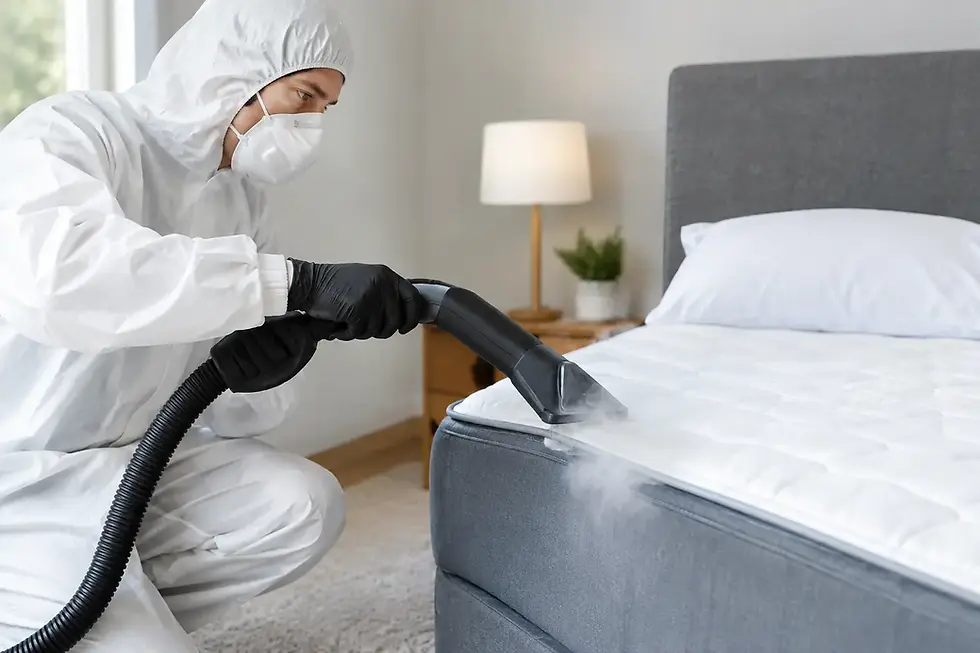
Technicians also focus on migration zones. Bed bugs may retreat into voids, furniture joints, flooring edges or areas around pipework as conditions change. Handheld high-temperature equipment is used where targeted treatment is required. We do not guess, we monitor.
The aim is a single, planned visit that treats the infestation at source without relying on insecticides. That is particularly valuable where resistance to conventional chemicals is a concern, or where residents want to avoid repeated spray appointments in bedrooms, nurseries and occupied properties.
Mattress encasements versus heat: the practical difference
The simplest distinction is this: a mattress encasement manages one item, while professional heat treatment addresses the environment in which the infestation is living.
An encasement can be a sensible supporting measure after treatment. It protects the mattress, makes future checks simpler and gives occupiers reassurance that the bed is easier to inspect. It may also be practical where replacing a sound mattress would be unnecessarily costly.
Heat is the stronger option when there is evidence of an active infestation, particularly where bugs have been found beyond the mattress. Blood spots on a bed frame, insects in bedside furniture, bites affecting more than one room, or sightings in a lounge all point to a wider issue. In those circumstances, fitting a cover may conceal the problem rather than solve it.
There is also a time factor. An encasement depends on long-term isolation and careful use. A controlled heat treatment is intended to deliver eradication in one visit, subject to correct preparation and treatment conditions. For landlords preparing a property, hotels protecting guest confidence, or households exhausted by recurring bites, that difference is significant.
When an encasement is worth using
Mattress encasements are not pointless. They are useful when chosen for the right reason and used as part of a wider plan. After professional treatment, they can protect a mattress and make inspections less complicated. They are also helpful for mattresses that have many stitched seams, handles or damaged labels where visual checks are otherwise difficult.
Choose a cover specifically designed for bed bugs, not a standard waterproof mattress protector. Check that the zip is fully enclosed, the fabric is tear-resistant and the size matches the mattress properly. Once fitted, inspect it occasionally for tears or gaps, especially around the zip and corners.
Do not move an infested mattress through a shared hallway, communal stairwell or hotel corridor without protecting it first. That can spread bed bugs to other areas. If disposal is necessary, seek professional advice on containing and handling the item safely.
When heat treatment is the better decision
Professional heat treatment is usually the right decision where there are confirmed bed bugs, uncertainty over how far they have spread, or a history of unsuccessful spray treatments. It is particularly effective for properties where speed, discretion and reduced chemical use matter.
Heat treatment is not a shortcut that ignores preparation. Residents or property managers will receive clear instructions before treatment. Certain heat-sensitive items need to be removed or managed, clutter may need reducing, and access to affected rooms must be available. Proper preparation allows heat to circulate and lets technicians inspect key areas thoroughly.
The treatment must also be delivered by people who understand heat movement inside real buildings. Thick furniture, dense possessions, insulated voids and awkward room layouts all affect how temperature travels. A professional operator monitors conditions throughout rather than relying on an air-temperature reading near a heater.
For commercial premises, this precision protects more than bedrooms. Hotels, hostels, offices and care-sensitive environments need a treatment plan that considers occupied areas, furnishings, access restrictions and business continuity. The objective is always the same: expose hidden bed bugs and eggs to verified lethal conditions, not simply make the room feel hot.
Do not let a cover create false reassurance
A mattress encasement can make a bed look clean while bed bugs remain active in the frame, headboard or surrounding room. That is the central risk of treating encasements as a replacement for eradication. Bites may continue, insects may spread, and a small problem can become harder to control.
If you have found a bed bug, avoid sleeping elsewhere if possible. Moving to a sofa or spare room can encourage bugs to follow and establish new harbourages. Avoid using over-the-counter foggers as well. They rarely reach hidden insects effectively and can drive them deeper into cracks and adjoining spaces.
Instead, preserve evidence where possible, inspect the bed structure and adjacent furniture, and arrange a specialist assessment. A precise treatment plan is more valuable than repeated guesswork.
An encasement is a useful protective tool. Heat is an eradication method. Used in the right order, they can complement each other - but when bed bugs are already active, the priority is to remove the infestation from the whole affected environment, not merely zip it inside the mattress.


Comments