


Chemical Free Treatment Versus Pesticides

A bed bug problem rarely starts with a simple decision. You may have found bites, blood spotting or live insects around the bed, and now need an answer that works first time. The choice between chemical free treatment versus pesticides affects how quickly you can use the room again, what preparation is required and, most importantly, whether eggs and hidden insects are properly dealt with.
For established bed bug infestations, the key question is not whether a treatment sounds familiar. It is whether it can reach every life stage in the places bed bugs actually hide. That means seams, bed frames, skirting boards, sockets, furniture joints, luggage, upholstered items and nearby migration routes.
Chemical Free Treatment Versus Pesticides: The Core Difference
Pesticide treatment relies on insecticidal products being applied to targeted areas. Depending on the active ingredient and treatment plan, insects may need to cross treated surfaces or absorb the product before they die. This can be effective when correctly specified, applied and supported by follow-up visits.
Chemical-free heat treatment works differently. Industrial heaters raise the temperature within the treated space to a level lethal to bed bugs, fleas, moths and their eggs. The temperature must not simply become warm. It must be controlled, sustained and verified throughout the room, including the areas that are most difficult to heat.
This distinction matters because bed bugs do not remain conveniently exposed on a mattress. When disturbed, they can move into cracks, behind pictures, inside furniture, under flooring edges and into adjacent rooms. A professional heat treatment is designed to treat the entire affected environment, rather than relying solely on an insect encountering a residual chemical.
Why Insecticide Resistance Changes the Decision
Repeated pesticide exposure has contributed to insecticide resistance in bed bug populations. In practical terms, a product that once produced reliable results may no longer perform as expected against a particular infestation. This is one reason recurring bed bug cases can become frustrating, costly and disruptive for households, landlords and hospitality businesses.
Resistance does not mean every pesticide treatment will fail. It does mean that product selection, application accuracy, infestation size and follow-up are critical. A quick spray from a general retailer is particularly unlikely to resolve a well-established infestation, and may drive insects deeper into their harbourages or into neighbouring rooms.
Heat does not depend on an insect's resistance to a chemical active ingredient. When lethal temperatures are achieved and held for the required period, heat kills live bed bugs and eggs. That gives it a major advantage where previous spray treatments have failed or where certainty is required quickly.
Precision Is What Makes Heat Treatment Effective
Professional heat treatment is not a matter of placing heaters in a room and hoping for the best. Poorly managed heat can leave cold spots inside dense furniture, beneath piled belongings or around poorly circulated areas. Those cooler pockets are where surviving insects and eggs may remain.
A specialist process uses industrial heat machines alongside high-volume air movement to circulate heated air. Wireless sensors monitor temperatures remotely at multiple points, while thermal imaging helps identify cold spots that need attention. The treatment team adjusts equipment and airflow as conditions change. We do not guess, we monitor.
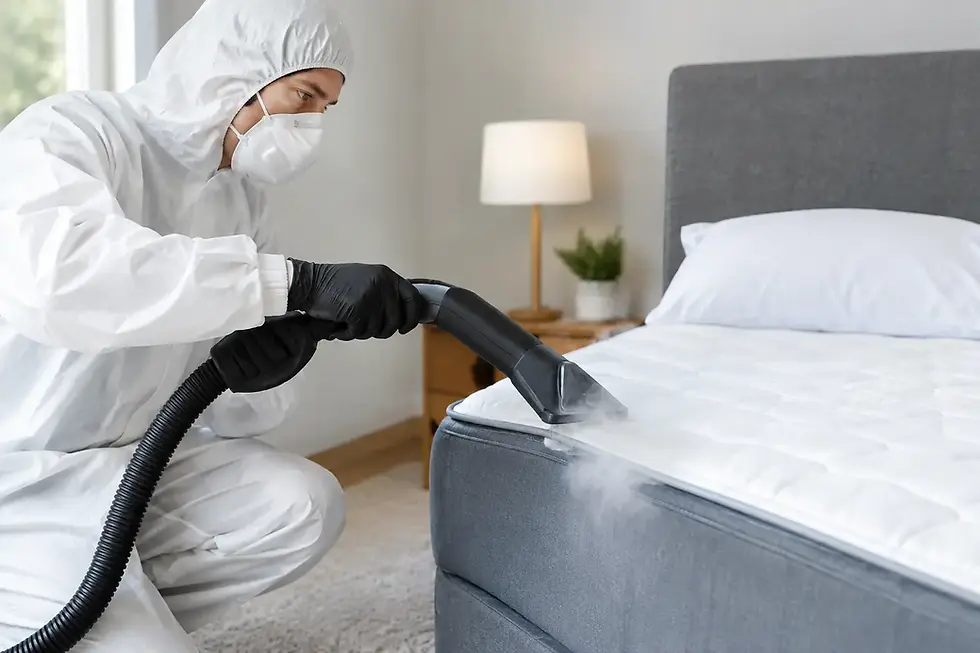
Handheld high-temperature equipment is then used for difficult areas and likely migration zones, including bed structures, sofa joints, floor edges and furniture voids. This combination of whole-room heating and targeted detail work is what turns heat from a general idea into a controlled eradication process.
The objective is sustained lethal exposure, not a high reading on one thermometer. Every room, property layout and infestation behaves differently, which is why an inspection and treatment plan should come before any promise of a one-size-fits-all solution.
Safety, Access and Daily Disruption
Many people choose a chemical-free option because they want to avoid insecticide residues in bedrooms, nurseries, hotels and furnished rental properties. After a properly managed heat treatment, there are no pesticide residues left on mattresses, carpets, bedside cabinets or soft furnishings.
That does not mean heat treatment requires no preparation. Heat-sensitive items must be identified and protected or removed before treatment. This can include certain candles, aerosols, medicines, houseplants, vinyl records, delicate cosmetics and items that may be damaged by high temperatures. Pets and people must also be out of the treatment area while work is underway.
Pesticide treatment has different restrictions. Occupants may need to vacate rooms during application and for a specified period afterwards. Treated surfaces may need to remain undisturbed so the product can continue working, and cleaning too soon can reduce its residual effect. Where residents include babies, people with sensitivities or pets, these considerations can carry significant weight.
For hotels, hostels and landlords, the operational difference is equally important. A prolonged programme of spray visits can mean keeping rooms out of service and managing repeated access arrangements. A professionally planned heat treatment can often eradicate an infestation in a single visit, reducing the period in which a room is unavailable. However, the exact timetable depends on the scale of infestation, room contents and the treatment area.
Cost: Compare the Whole Outcome, Not the First Quote
Pesticide treatment often appears less expensive at the outset. That can be true for a small, early-stage problem where the insects are susceptible, access is good and multiple visits are practical. But the initial price is not the only cost.
If treatment requires repeat applications, lost room nights, tenant disruption, additional inspections or replacement of contaminated furnishings, the overall figure can rise quickly. Failed treatments also create a confidence problem. In a hotel or shared property, one unresolved infestation can affect reviews, occupancy and relationships with residents.
Heat treatment is typically a premium specialist service because it requires industrial equipment, trained operators, continuous monitoring and detailed preparation. Its value lies in treating the infestation comprehensively, including eggs, without waiting for insects to contact treated surfaces over time.
The right comparison is therefore not simply heat treatment versus the cheapest spray. It is the likely cost of complete eradication, the number of visits involved, the disruption to the property and the consequences if the infestation returns.
When Pesticides May Still Have a Place
A no-nonsense assessment should recognise that pesticides are not automatically the wrong choice. They may form part of an integrated pest management plan for certain insect problems, in exterior areas, voids that cannot be heat-treated or situations where a full-room heat programme is not feasible.
For bed bugs, a targeted chemical approach may suit a very limited infestation caught early, provided the treatment is carried out by a competent professional and follow-up is possible. It may also be used as a supplementary measure in carefully assessed circumstances.
But where there is evidence of an established infestation, repeated spray failure, insecticide resistance or a need to protect sensitive occupied spaces, chemical-free heat treatment is usually the more decisive option. It treats the problem at the source rather than asking occupants to live around a long residual-treatment cycle.
Choosing a Provider Who Can Prove the Treatment
Ask how temperatures will be measured, where sensors will be placed and how cold spots are identified. Ask whether the provider treats furniture interiors and migration routes, not just the centre of the room. You should also understand what preparation is needed, how long the property will be unavailable and what guarantee applies.
Avoid providers who promise eradication without discussing inspection, monitoring or the layout of the property. Bed bugs are persistent because they exploit overlooked spaces. Effective control comes from methodical work, not a fast application and a hopeful return visit.
Extreme Heat Treatments UK provides monitored, single-visit heat eradication for bed bugs and other insect infestations, with a 100% guarantee. The focus is precise temperature control, detailed treatment of harbourages and a result that can be measured rather than assumed.
If you are weighing up chemical free treatment versus pesticides, choose the method based on the infestation you have, not the label that sounds easiest. A properly planned treatment should give you a clear route back to a clean, usable and confidently pest-free property.


Comments